Is AI Summarization Really 10x Faster Than Manual Note-Taking?
Taking notes during a meeting is actually a strange act.
You're trying to listen and write at the same time. When something important is said, you grab your pen, but in that moment, you miss the next sentence. When the meeting ends, you're left with half-sentences, missing contexts, and notes where you ask yourself, "Why did I even write this?"
At best, writing a meeting summary afterward takes 15-20 minutes. Most of the time, it's never written at all.
What if this process were completely automatic?
The Real Cost of Manual Note-Taking
Studies looking at the practice of note-taking in companies reveal a consistent picture: only 30% of meeting participants take active notes during the meeting. The majority of these notes are never opened again after 24 hours.
Why? Because handwritten notes usually only make sense to the person who took them. Abbreviations, incomplete sentences, references requiring context — most of their value is lost when shared with others.
Furthermore, the person taking notes cannot fully participate. Research shows that people trying to perform two cognitive tasks simultaneously experience a decrease in performance in both.
How Long Does AI Summarization Take?
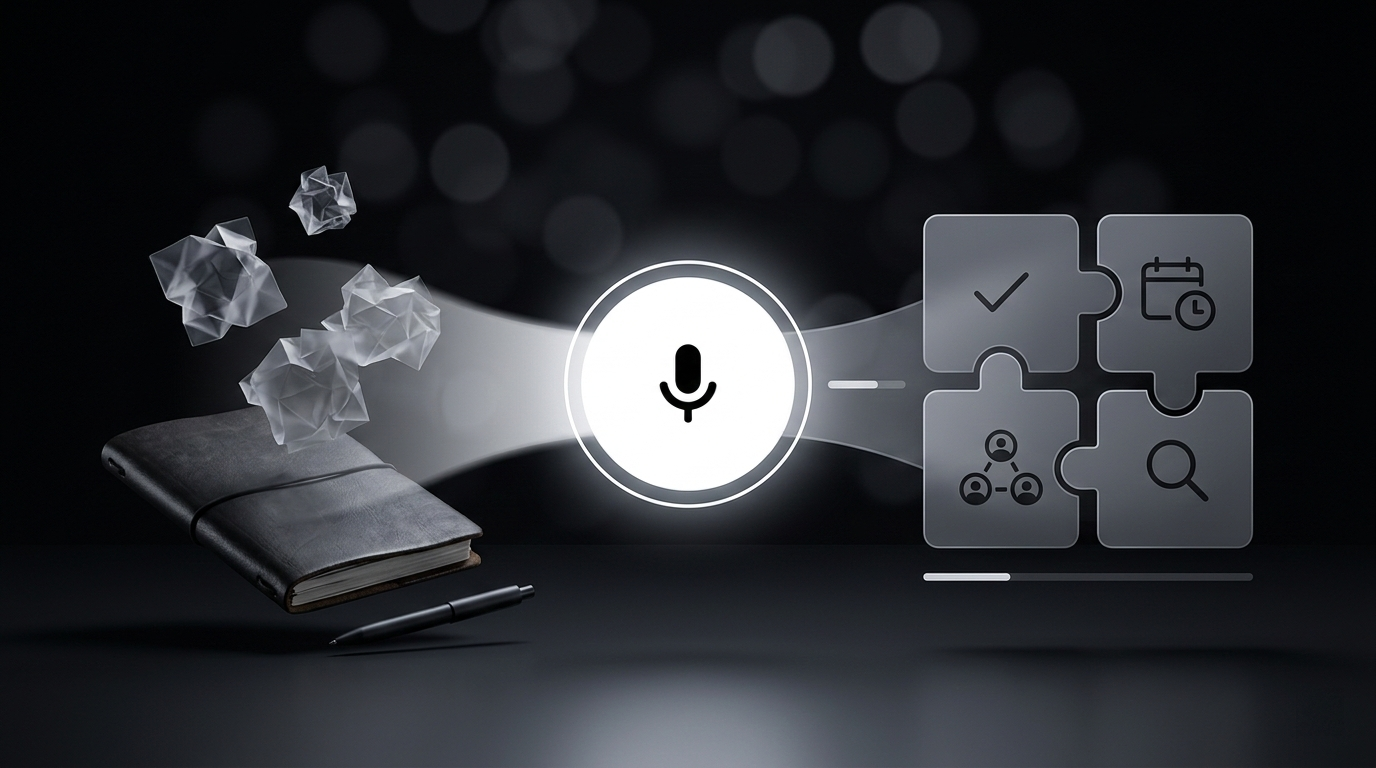
When you record a meeting with Brief, the process works like this: The moment the meeting ends, the system kicks in. Audio is converted to text, who said what is distinguished, and AI extracts the executive summary, decisions, and action items in seconds.
Whether the meeting lasted 1 hour or 3 hours, the summary is ready in just a few minutes.
Comparison Table
| Feature | Manual Note-Taking | Brief AI |
|---|---|---|
| Attention Spent | Divided | Full |
| Preparation Time | 15-30 minutes | Automatic (Seconds) |
| Action Items | Manual | Named + Dated |
| Searchability | Impossible | Instant |
| Sharability | Low | High |
Speed is Not the Only Gain
10x speed is a catchy title, but the real difference isn't in speed — it's in quality.
Brief never gets tired. The first minute of the meeting is processed with the same precision as the last. A sentence saying "let's deliver next Friday" results in an action item, whether it was said at 9 AM or 5 PM.
Another key difference: Meeting Memory. When you wonder what decision you made in a meeting three months ago, you can open that meeting or ask the AI directly: "What was the decision in last month's budget sync?"
Final Word
Manual note-taking doesn't have to retire. But it doesn't have to be the only option anymore either.
It's possible to get automatic summaries, instantly see who's responsible for which action items, and find a decision from 6 months ago in seconds.
Try Brief in one of your meetings. Your first meeting is free.
Brief — Let your meetings end, and your decisions stay.